Sit, Drop, Stay – Teaching Basic Commands

Admin
Published On Feb 23,2026
When most people think about puppy training, they picture basic commands.
Sit.
Drop.
Stay.
They seem simple. And they are — when they’re taught properly.
But these cues aren’t just party tricks. They form the foundation for calm behaviour, impulse control and safety in everyday life.
The way you teach them matters just as much as the commands themselves.
Start with the right mindset
Puppies don’t understand words automatically. “Sit” is just a sound until we attach meaning to it.
The key is to:
- Show the behaviour first
- Reward it clearly
- Then add the word
If you repeat “sit, sit, sit” while your puppy stares at you blankly, the word loses meaning.
Clarity builds reliability.
Teaching Sit
Sit is often the easiest to begin with.
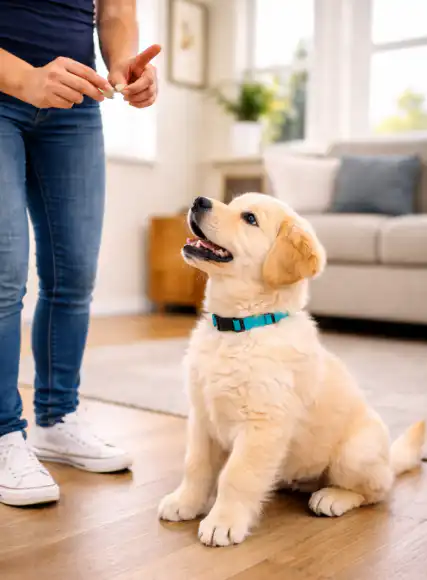
Hold a small treat at your puppy’s nose and slowly move it upwards and slightly back over their head. As their head follows the treat, their bottom will naturally lower.
The moment their bottom touches the ground, reward.
After several repetitions, once they’re offering the sit reliably, you can begin saying “sit” just before you move your hand.
Sit quickly becomes your go-to behaviour for greetings, attention and impulse control.
Teaching Drop
“Drop” (lying down) encourages calmness.
From a sit, lower a treat slowly to the ground between their paws, then gently move it forward along the floor. As their nose follows, their elbows will lower.
The moment their body is fully down, reward.
Some puppies find drop harder than sit. Be patient. If they pop back up, simply reset and try again without frustration.
Drop is incredibly useful for helping excitable puppies settle.
Teaching Stay
Stay is where many people rush.
Before you add duration or distance, your puppy must understand the position itself.
Ask for a sit or drop. Pause for one second. Reward.
Gradually build the time before rewarding. Then begin taking a tiny step back and returning before rewarding.
If your puppy moves, you’ve increased the difficulty too quickly. Go back a step.
Stay is about self-control. It should be built gradually, not tested early.
Keep sessions short
Puppies learn best in short bursts.
Two to five minutes is often enough. Finish while your puppy is still engaged.
Multiple short sessions each day are far more effective than one long session.
Common mistakes
- Repeating the cue over and over
- Moving too fast with duration or distance
- Training when your puppy is overtired
- Expecting reliability in distracting environments too soon
Proofing commands in real life comes after they understand them clearly at home.
Why basic commands matter
Sit, drop and stay are not about obedience for obedience’s sake.
They teach your puppy to pause, think and respond.
That pause can prevent jumping on guests. It can stop dashing out a door. It can create calm instead of chaos.
They are the building blocks for everything else.
At Paws Claws & Tails, we teach these cues properly in our Puppy School on the Sunshine Coast.
We don’t just show you how to get a quick sit. We teach you how to build reliability, how to layer distractions gradually, and how to use these behaviours in real-life situations — at home, around visitors and out in public.
Basic commands become powerful tools when they’re taught with structure and understanding.
If you’d like guidance in building those foundations properly from the start, you can learn more about our Puppy School here:
Simple commands. Taught well. Used daily. That’s what creates calm, confident dogs.