How to Stop Puppy Biting (Mouthing)

Admin
Published On Feb 23,2026
If you have a young puppy, chances are you’ve said at least once, “Why won’t you stop biting me?”
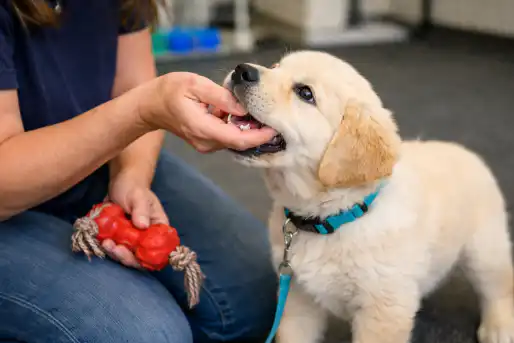
Puppy biting — or mouthing — is completely normal. It’s how puppies explore the world. They don’t have hands. They use their mouths.
That said, normal doesn’t mean you have to live with shredded sleeves, sore hands and kids who are scared to walk past the dog.
The key is understanding why it happens, and what to do about it properly.
Why puppies bite
Most puppy mouthing happens for one of four reasons:
Teething
Play
Over-tiredness
Over-arousal
Between 8 and 16 weeks especially, puppies are learning bite inhibition — how much pressure is too much. If they don’t learn this early, the behaviour can continue into adolescence, where it becomes much harder to manage.
The mistake many owners make is either allowing it sometimes and stopping it other times, or reacting in a way that accidentally turns it into a game.
Consistency matters.
First: manage the situation
Before you “train” anything, reduce opportunities for biting.
- Make sure your puppy is getting enough sleep. Overtired puppies bite more.
- Provide appropriate chew toys and rotate them.
- Avoid rough hand play.
- Supervise interactions with children closely.
If your puppy is wild, zooming around and biting everything, that’s often a tired puppy who needs a calm wind-down, not more stimulation.
Don’t turn it into a wrestling match
Pulling your hands away quickly, squealing dramatically, or pushing the puppy can escalate excitement. For many puppies, this becomes more fun.
Instead, stay calm and predictable.
If teeth touch skin:
- Stop interaction immediately.
- Remove attention.
- Stand up and step away for a few seconds.
No yelling. No big reactions. Just calm removal of what they wanted — your attention.
Puppies learn very quickly that biting makes the fun stop.
Teach what to do instead
Simply stopping biting isn’t enough. You must show your puppy what behaviour earns attention.
Reward:
- Sitting calmly
- Licking instead of biting
- Bringing a toy
- Four paws on the floor
The clearer you are about what works, the faster the mouthing fades.
Use toys properly
If your puppy is particularly mouthy, have a toy ready before engaging with them.
When they go to bite, calmly redirect to the toy. When they chew the toy instead, praise and engage.
This teaches them that toys are for teeth. Humans are not.
What not to do
Avoid:
- Smacking their muzzle
- Holding their mouth shut
- Shouting
- Scruffing
- Alpha-style dominance techniques
These can create fear, frustration or defensive behaviour — and they do not teach true bite inhibition.
When is it more than normal?
If your puppy:
- Growls stiffly while biting
- Guards items
- Snaps when handled
- Shows escalating intensity
Then it’s time for structured guidance. Early intervention prevents future behavioural issues.
The truth about puppy biting
Almost every puppy bites.
Almost every puppy can learn not to.
But it doesn’t fix itself. It improves when owners are shown exactly how to handle it consistently and calmly.
This is one of the biggest reasons people join our Puppy School at Paws Claws & Tails on the Sunshine Coast. We don’t just teach sit and stay. We coach you through real-life issues like mouthing, jumping, settling, and handling.
You’ll learn how to read your puppy’s arousal levels, how to prevent over-tired biting episodes, and how to build calm behaviour from the start.
If you’re feeling frustrated, you’re not alone — and you don’t have to guess your way through it.
You can learn more about our structured, practical Puppy School classes here:
https://pawsclawstails.com.au/puppy-school-sunshine-coast/
The biting stage doesn’t have to define your puppy’s future. With the right guidance early on, it becomes just a short phase — not a long-term habit.