Preventing Separation Anxiety in Puppies

Admin
Published On Feb 23,2026
Separation anxiety doesn’t start when a dog is one year old and suddenly “can’t cope.”
It usually starts in the early weeks — quietly — when a puppy never learns how to be alone.
Many new owners understandably spend a lot of time with their puppy at first. They take time off work. They supervise constantly. The puppy sleeps beside them. Follows them everywhere. Is rarely out of sight.
It feels loving. And it is.
But if a puppy never practises being alone in small, safe doses, they don’t build the skill of independence. Then one day, real life resumes — and the puppy panics.
The goal isn’t to make your puppy independent overnight. It’s to build confidence gradually.
What separation anxiety actually looks like
True separation anxiety is more than mild whining.
It can include:
- Persistent barking or howling
- Destructive behaviour near doors or windows
- Toileting indoors when previously trained
- Excessive drooling
- Panic responses when you prepare to leave
Prevention is far easier than rehabilitation. And it starts early.
Start with micro-absences
Independence is built in seconds at first, not hours.
Begin by:
- Leaving the room for 10–20 seconds
- Returning calmly before your puppy becomes distressed
- Repeating several times a day
There’s no big goodbye. No dramatic return. Just calm, neutral comings and goings.
Gradually increase duration as your puppy remains relaxed.
If you wait until they’re already upset, you’ve gone too far.
Teach your puppy to settle away from you
If your puppy follows you everywhere, start gently encouraging space.
Use a bed or crate and reward calm behaviour when they lie down independently. Step a short distance away while they remain settled. Return before they feel the need to get up and follow.
You’re teaching them that being apart from you is safe.
This is different from forcing separation. It’s structured confidence-building.
Avoid creating over-dependence
Some common habits that unintentionally increase attachment:
- Carrying the puppy everywhere
- Allowing constant physical contact
- Letting them sleep pressed against you every nap
- Never closing doors between rooms
Affection is important. But balance is too.
Your puppy should experience calm alone time every day, even if you are home.
Use enrichment wisely
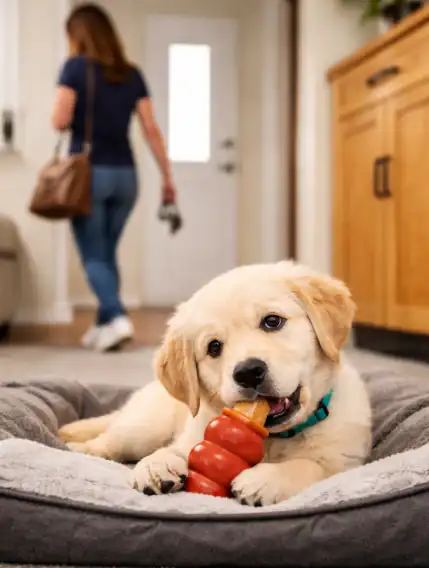
Before short departures, provide something appropriate to chew or work on, such as a stuffed food toy.
This builds a positive association with your absence. Leaving predicts something good.
However, enrichment is support — not a replacement for gradual independence training.
Don’t make departures emotional
Long goodbyes and excited greetings can heighten emotional intensity around your movements.
Keep leaving and returning calm and low-key.
The message you want your puppy to learn is simple: people come and go, and it’s no big deal.
Early structure prevents bigger problems
The first few months shape how your puppy handles alone time long-term.
At Paws Claws & Tails, we guide owners through this process in our Puppy School on the Sunshine Coast. We show you how to balance bonding with independence, how to prevent anxious attachment, and how to build genuine confidence — not forced tolerance.
We also work through settling skills, crate training, toilet training, jumping and mouthing, because all of these behaviours connect.
If you’re unsure whether you’re building independence correctly, structured guidance early on can make all the difference.
You can learn more about our Puppy School here:
Separation anxiety isn’t something that appears overnight. But with calm, gradual training from the beginning, it’s something you can often prevent altogether.